

Dear reader
It has been a while since I have last wrote to you, and I apologise profusely. Instead of lamenting on excuses and reasons why, lets rather get straight into this edition of the Cultured Carp.
This edition explores the world’s first biodiversity credit, launched in 2019 (Cercarbono 2025), and follows a similar concept to carbon credits in that each credit represents a measured unit of conserved biodiversity, such as a species or habitat (depending on the credit in question). The credit was developed and launched by Savimbo, a social enterprise by and for Indigenous peoples and local communities to access climate markets directly (Savimbo 2025).

The methods behind their biodiversity credit were co-developed with the Indigenous peoples and local communities behind the project. The credits were then launched to global markets with conservation scientists so that like-minded individuals could access them (Savimbo 2024a).
Their initial methodology was first certified by Cercarbono (a carbon credit certifier) under the Cercarbono Biodiversity Certification Programme (CBCP) on 14 August 2025 (six years after launching), and the Savimbo Biodiversity Putumayo Project (CDB-1, in the Colombian Amazon) is being tracked by EcoRegistry (a transparent, traceable blockchain enabled platform with safeguards against double counting).
“The credits were generated using the Indicator Species Biodiversity Methodology (ISBM v1.2), approved under CBCP: a science-based approach that tracks and quantifies ecosystem integrity through direct monitoring of 56 indicator species, including endangered and vulnerable flora and fauna” - (Cercarbono 2025).
For full details regarding the methodology please see Savimbo (2024a).
Savimbo’s biodiversity unit
Savimbo’s co-developed biodiversity unit is area based and as such is interoperable between different ecosystems and is calculated from indicator species: where 1 unit represents a “…fixed Area of one hectare, for a fixed Time of one month with measured Integrity reported on a scale from 0-1. Where full integrity is an ecosystem with every ecological niche available to, and filled by, native species [the indicator species]. The unit is independently categorized by its location and assigned a Value (Platinum, Gold, Silver, Bronze) representing the underlying biodiversity density and threat of the ecosystem” (Savimbo 2024b).
Their methodology states that indicator species must have a documented sensitivity to environmental changes and an ability to represent the integrity of the broader ecosystem (even if only partially). Projects must characterise a full list of the potential indicator species for their ecosystem, and such lists are in the process of being normalised in public databases by independent experts (Savimbo 2024a).
The following figures attempt to demonstrate the underlying calculations of the unit (see Savimbo 2024b):
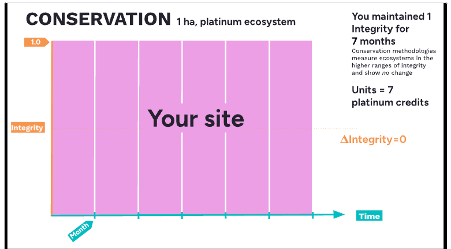
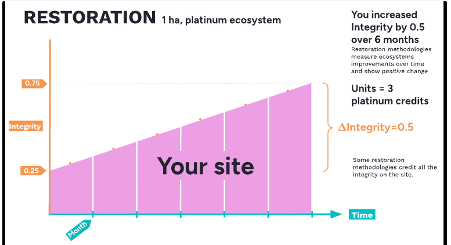
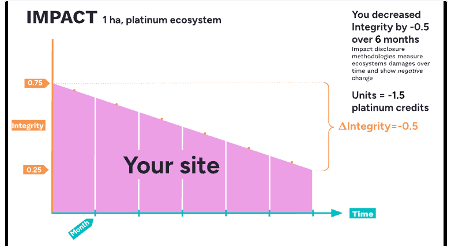
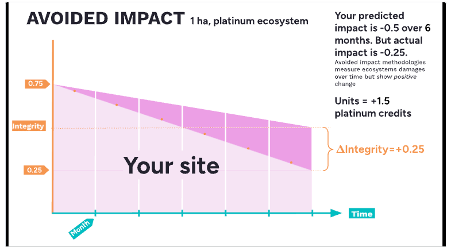
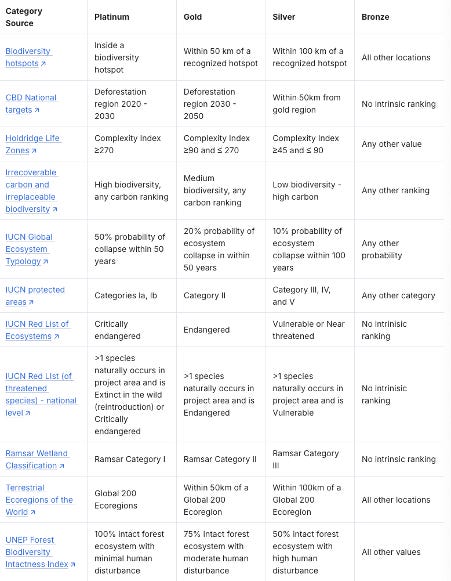
The value the units are assigned are determined by public data on global ecosystem value and threat (see Savimbo 2024c for more details, Table 1), and have been normalised into four categories - in increasing order: Bronze, Silver, Gold, and Platinum (Savimbo 2024c).
Table 1: Ecosystem value sources based on public data (not all records shown, Savimbo 2024c).
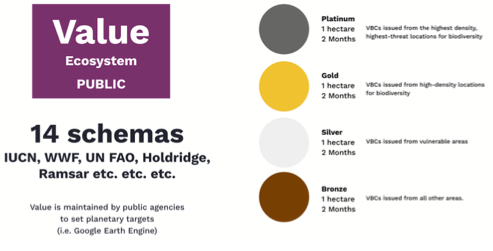
Savimbo states that the relative monetary value of different value credits will be determined by the market demand for each type of credit and with market standardization, represent publicly-recognized priorities for preservation (Savimbo 2024c). The unit is increasingly being adopted, and has received significant interest from “…eradication, restoration, pollination, and agrobiodiversity crediting methodology developers” (see Savimbo 2024d for list of current adoptors).
Savimbo’s intention is that their biodiversity credits should not be used for biodiversity offsetting, as they do not believe it is moral or ethical to trade in species or nature, as it violates the values of Indigenous peoples (Nature and Biodiversity Pulse 2025…unfortunately need a subscription but they offer a free trial period) and the rights of Nature (RightsofNatureNow 2025…petition).
“This methodology issues voluntary biodiversity credits (VBCs). As such, it can never be used to provide “offsets” of any kind. Its authors do not believe that it will ever be ethical to trade a chimpanzee for a jaguar, or one IP group's jaguar for another's.” - Savimbo (2024)
However, they also state that they can not prevent people from trading their biodiversity credits (Savimbo 2024b), but they are against it in the strongest terms.
“While carbon is a basic element and can be emitted and sequestered from the atmosphere, a living species cannot be cycled between death and life… We do think interoperable tracking for impacts is desirable at global, national, and corporate levels. But do not endorse financial transactions that do not value life.” – Savimbo (2024b)
Some thoughts:
I can certainly foresee biodiversity offsetting being valuable to large corporations or extractive industries such as mining and capture fisheries, which will ultimately incentivise trade in biodiversity credits. The Savimbo biodiversity credits are currently designed as voluntary credits, and they state that these are thus unable to represent offsets, and thus exist more as a verified method to support conservation efforts. With this line of reasoning, I am not sure how useful this is beyond gauging impact investing, or for company marketing/advertising and self-promotion…
However, trade of biodiversity credits for offsetting may be inevitable: The credits function as an interoperable conservation tracking solution, and as such are of immense significance in tracking and measuring conservation obligations of national governments such as the 30x30 conservation targets (where countries agree to conserve at least 30% of their land, waters, and seas by 2030) under the Kunming-Montreal Global Biodiversity Framework; similar to the way in which carbon credits are used on the compliance carbon market such that countries can fulfil their carbon removal obligations (known as Nationally Determined contributions or NDCs) under the Paris Agreement.
Having said that, one way of avoiding trade of the biodiversity credits as commodities between third-parties are that they are “cashed out” with immediate effect upon purchase, meaning that one could then only lay claim to supporting conservation for one month from the date of purchase logged on a blockchain registry. One will not be able to “hold” these credits to cash-out at a later date. How this translates into national conservation obligations on compliance markets is not clear, but I would imagine a practical solution would be to place a purchase order for the biodiversity credits in advance with a planned date for “cashing-out” (logging the offsetting potential) such that national governments could time their purchases (official support for conservation) to align with annual or monthly conservation obligations according to international agreements or national development plans.
Biodiversity credit markets, systems and methodologies are still nascent and it will be interesting to see how they evolve over the next 20 years or so. Nonetheless, Savimbo and the Indigenous peoples and communities involved in the development of their biodiversity credit unit should be commended for driving the development of biodiversity credits forwards.
I notice that this biodiversity credit was also first developed with terrestrial based ecosystems first instead of marine systems, likely due to ease of accessibility. I do find it interesting that it follows the same trend as the development of the green economy first then the blue economy; green financing first, then blue financing thereafter…Given all of the work it takes, hopefully we won’t have to wait too long for marine biodiversity credits or units to be developed…
Ciao for now
The Cultured Carp
References:
Cercarbono (2025). Now Available – First ever CBCP-certified Biodiversity credits. Online web page. Available at: https://cercarbono.com/first-cbcp-certified-biodiversity-credits-issued Accessed on 30 August 2025
EcoRegistry (2025). Homepage. Online webpage. Available at: https://www.ecoregistry.io Accessed on 30 August 2025
Nature and Biodiversity Pulse (2025). BCA’s Indigenous Peoples panel releases biodiversity credits recommendations, opens consultation. Online web article. Available at: https://carbon-pulse.com/269182 Accessed on 30 August 2025
RightsofNatureNow (2025). Homepage. Online Webpage. Available at: https://rightsofnaturenow.com Accessed on 30 August 2025
Savimbo (2024a). Executive summary – ISBM methodology. Online webpage. Savimbo. Available online: https://isbm.savimbo.com Accessed at 30 August 2025
Savimbo (2024b). Executive summary – Interoperable Biodiversity Unit. Online webpage. Savimbo. Available at: https://unit.savimbo.com Accessed on 30 August 2025
Savimbo (2024c). Value – Interoperable Biodiversity Unit. Online webpage, Available at: https://unit.savimbo.com/value Accessed on 1 September 2025
Savimbo (2024d). Adoption – Interoperable Biodiversity Unit. Online webpage. Available at: https://unit.savimbo.com/adoption Accessed on 1 September 2025
Savimbo (2025). Homepage. Online web page. Savimbo. Available at: https://www.savimbo.com Accessed on 30 August 2025